
Singapore’s new private home market took a breather in August 2026, with 153 units sold excluding Executive Condominiums (ECs), compared with 731 units in July. The moderation was largely anticipated due to the absence of major new project launches and the Hungry Ghost Festival period, when developers traditionally take a more measured approach towards launches. As such, the lower sales volume primarily reflects launch timing and limited fresh supply rather than a significant shift in underlying homebuyer demand.
The quieter launch calendar gave previously launched projects greater visibility and a longer window to sustain marketing efforts and convert buyer interest. July launches Dunearn House and Lentor Gardens Residences emerged as August’s two best-selling projects. Dunearn House recorded 18 units sold at a median price of $3,008 psf, while Lentor Gardens Residences sold another 15 units at a median $2,367 psf. Their continued sales indicate that buyer interest carried through beyond the initial launch period despite the quieter primary market.
Other projects continued to record transactions. Coastal Cabana EC and The Sen each sold 12 units, followed by Union Square Residences with 10 units and Hudson Place Residences with nine. Arina East Residences recorded eight sales, while Chuan Park, Narra Residences and Rivelle Tampines EC each sold six units. The project table on page 2 shows that demand remained spread across the Core Central Region, Rest of Central Region and Outside Central Region.
Existing EC projects under the previous framework also remained well absorbed. As of August, Aurelle of Tampines, North Gaia, Otto Place and Rivelle Tampines had each sold more than 97% of their units. Coastal Cabana was 82.1% sold, with 134 units remaining. The EC market is entering a transition following policy measures introduced in May and the subsequent National Day Rally announcement, which raised the EC household income ceiling from $16,000 to $18,000 for projects on sites where land sale tenders close on or after 24 August 2026. Existing projects and sites awarded before the effective date will continue under the previous framework.
Looking ahead, September could remain relatively measured amid the school holiday period, although the new home market is positioned for a subsequent pickup. Upcoming projects including Amberwood at Holland, Lucerne Grand, Thomson Reserve and The Serra Residences are expected to introduce fresh residential supply and broaden homebuyer choices across different locations and market segments.
The return of major launches should help reenergise primary market activity, with sales momentum for the remainder of 2026 increasingly shaped by the timing, pricing and market reception of these developments. External economic and financing conditions are also expected to become increasingly important considerations for homebuyers as the market moves into the next phase of its launch cycle.
Click here for the full report:
Prepared By:
Mohan Sandrasegeran
Head of Research & Data Analytics
Email: mohan@sri.com.sg
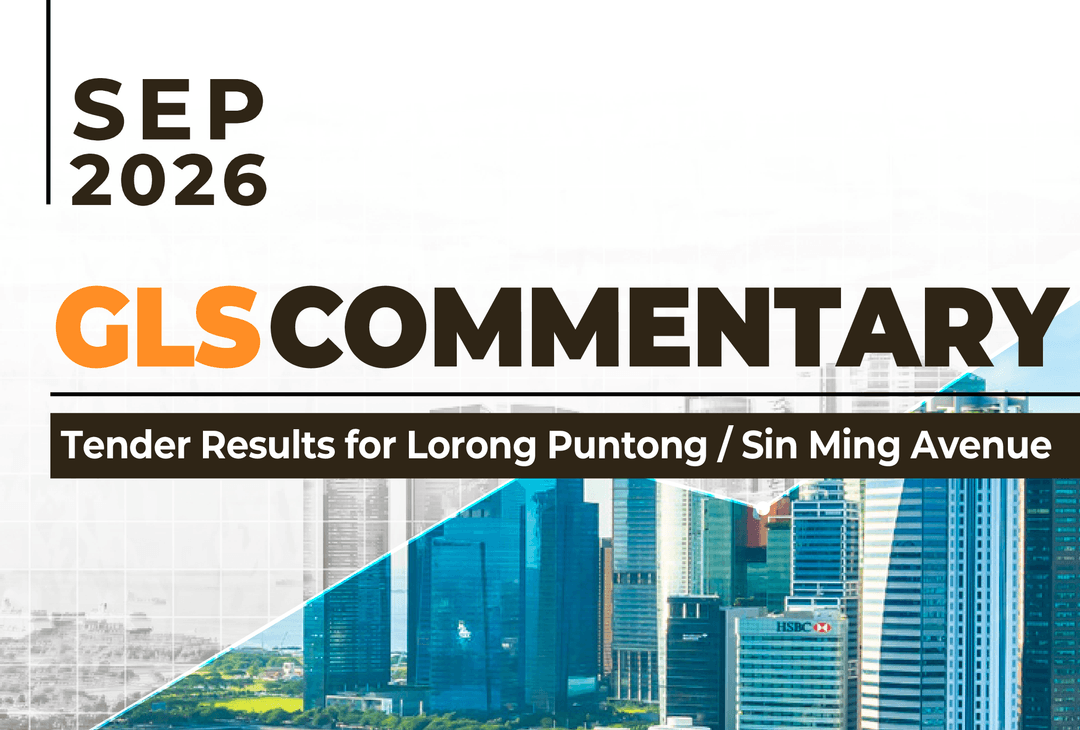
The Lorong Puntong / Sin Ming Avenue Government Land Sales (GLS) site attracted seven bids, with Eco World Development (S) Pte. Ltd. submitting the highest offer of $208.1 million, equivalent to $1,612 psf ppr. The next highest bid, from Intrepid Investments Pte. Ltd. and TID Residential Pte. Ltd., was $187.3 million or $1,451 psf ppr. The site is expected to yield approximately 140 residential units, providing an opportunity for a relatively smaller-scale private residential development within the established Upper Thomson and Bishan catchment.
A key attribute of the site is its proximity to Bright Hill MRT station, which provides convenient access to the Thomson-East Coast Line and direct connectivity towards Orchard, Marina Bay and the CBD. Longer term, Bright Hill is expected to become an interchange with the future Cross Island Line, further enhancing east-west connectivity and access to employment, commercial and lifestyle nodes across Singapore. The site also benefits from an established education catchment that includes Ai Tong School, CHIJ St Nicholas Girls' School, Catholic High School and Raffles Institution.
The wider Bishan area's continued evolution could further support the site's appeal. Planning initiatives associated with the rejuvenation of Bishan Town Centre are expected to strengthen commercial, community and public spaces while expanding employment and amenity offerings. Meanwhile, the upcoming launch of Thomson Reserve could build greater market awareness of the Upper Thomson and Sin Ming locality, establish fresh pricing benchmarks and demonstrate underlying demand ahead of the future Lorong Puntong development.
From a developer perspective, the relatively modest unit count could offer a more manageable project with lower overall capital commitment and potentially reduced sales and execution risk compared with substantially larger developments. For buyers, the project could provide a smaller and potentially more intimate residential environment within the established Bishan and Upper Thomson catchment.
Click here for the full report:
Prepared By:
Mohan Sandrasegeran
Head of Research & Data Analytics
Email: mohan@sri.com.sg
Singapore’s residential rental market remained resilient in the first half of 2026, with the overall private residential rental index rising by 1.0%, following the 1.2% increase recorded in 1H2025. The measured increase points towards a more balanced and sustainable rental environment, as the market continues to absorb the wave of private housing completions delivered over the past two years. Leasing demand remains supported by Singapore’s resilient labour market, continued inflow of expatriate professionals and stable economic conditions.
Leasing demand was also well distributed across individual developments. Normanton Park emerged as the most actively leased RCR project with an estimated 426 transactions, while Treasure at Tampines led the OCR with 301 transactions. Within the CCR, Marina One Residences recorded 289 transactions, ahead of The Sail @ Marina Bay and The M. These trends highlight tenant preferences for accessibility, proximity to employment centres, lifestyle amenities and value for money.
Looking ahead, Singapore’s residential rental market is expected to remain broadly stable through the second half of 2026, with rental growth likely to stay measured. Approximately 5,012 private residential units are scheduled for completion over the remainder of 2026, expanding rental inventory and providing tenants with greater choice. The HDB market should also benefit from an expanding supply of flats reaching their Minimum Occupation Period, with around 18,000 flats expected to reach MOP in 2027 and approximately 21,000 in 2028. Overall, healthy underlying demand and increasing housing supply are expected to support a more balanced rental environment characterised by greater tenant choice, improved affordability and moderate rental growth.
Click here for the full report:
Prepared By:
Mohan Sandrasegeran
Head of Research & Data Analytics
Email: mohan@sri.com.sg

The New Upper Changi Road Government Land Sales (GLS) site attracted an exceptionally strong top bid of approximately $1.43 billion, or $1,537 psf ppr, from United Venture Development (Daisy) Pte. Ltd. and CL Sapphire Pte. Ltd., a joint venture between UOL and CapitaLand. The result represents a new record land bid for an Outside Central Region (OCR) residential parcel in recent memory, particularly notable given the site's substantial scale and capital commitment.
A key factor supporting the tender outcome is the relative scarcity of major new private residential projects around Bedok MRT. Sky Eden@Bedok, comprising 158 units, was launched in 2022 and sold more than 75% of its units during its launch weekend before achieving a complete sell-out by 2024. With no comparable major project launched in the immediate Bedok MRT vicinity since then, the eventual New Upper Changi Road development could tap into a refreshed pool of demand.
The site is expected to yield approximately 1,010 residential units, placing it firmly within the mega-development category. Its proximity to Bedok MRT station, Bedok Bus Interchange and Bedok Mall, together with the established schools, retail, food and healthcare amenities within the mature Bedok estate, should broaden its appeal to owner-occupiers, investors and particularly HDB upgraders from Bedok and the wider East region. The location map on page 2 further illustrates the site's immediate proximity to Bedok's established transport and amenity network.
Click here for the full report:
Prepared By:
Mohan Sandrasegeran
Head of Research & Data Analytics
Email: mohan@sri.com.sg
Singapore’s industrial property market remained resilient in the first half of 2026, with prices, transaction activity and rents continuing to rise despite a more uncertain global economic environment. According to JTC’s industrial property price index, prices increased by 1.8% in 1H2026, moderating from the 2.9% growth recorded in 1H2025. The continued expansion of Singapore’s manufacturing sector, supported by artificial intelligence-related demand across semiconductors, infocomms and consumer electronics, provided a supportive backdrop for the industrial market.
Strata industrial transaction activity also strengthened, with caveated sales increasing 4.3% year on year from 797 transactions in 1H2025 to 831 transactions in 1H2026. Multiple-user factories continued to dominate the market, accounting for 92.8% of strata industrial transactions.
Looking ahead, Singapore’s industrial property market is expected to remain resilient through the second half of 2026. Continued strength in electronics, semiconductors, precision engineering and other advanced manufacturing industries should underpin demand for modern industrial facilities. Growing adoption of AI technologies and investment in higher-value manufacturing activities are also expected to support demand for high-specification factories, logistics facilities and selected business parks.
Click here for the full report:
Prepared By:
Mohan Sandrasegeran
Head of Research & Data Analytics
Email: mohan@sri.com.sg

The housing measures announced at National Day Rally 2026 represent a timely recalibration of Singapore’s housing framework, with higher income ceilings expanding access to subsidised housing and mortgage support across different stages of the housing journey. The monthly household income ceiling for eligible families will increase from S$14,000 to S$16,000, while the corresponding ceiling for singles will rise from S$7,000 to S$8,000. For applicable future Executive Condominium (EC) projects, the household income ceiling will increase from S$16,000 to S$18,000.
For ECs, the increase to S$18,000 broadens the potential buyer pool, particularly among dual-income households that have moved beyond the revised HDB ceiling but remain within EC eligibility. However, the market impact will be gradual because the new ceiling applies only to new EC units where the land sale tender closes on or after 24 August 2026.
Overall, the measures represent a wider housing life-cycle recalibration rather than a change focused solely on BTO eligibility. By updating income thresholds across multiple housing programmes, expanding EC accessibility and providing additional ballot chances for first-time families with children from the February 2027 sales exercise, the framework broadens housing options while allowing eligibility parameters to evolve alongside household incomes and circumstances.
Click here for the full report:
Prepared By:
Mohan Sandrasegeran
Head of Research & Data Analytics
Email: mohan@sri.com.sg

Singapore’s primary residential market rebounded strongly in July 2026, with developers selling 731 new private homes excluding Executive Condominiums (ECs), up sharply from 156 units in June. The recovery was driven by the return of fresh residential supply after June recorded no new private residential launches, highlighting the close relationship between launch activity and monthly developer sales.
A total of 889 units were launched across six projects during July. Lentor Gardens Residences and Dunearn House accounted for the bulk of new supply, launching 499 and 250 units respectively. Together, the two projects contributed 749 units, or approximately 83.3% of all units launched during the month. Their strong performance also accounted for 65.9% of all new private homes sold excluding ECs, demonstrating the significant role that major new launches continue to play in shaping monthly sales volumes.
Lentor Gardens Residences was July’s best-selling project, recording 270 transactions at a median price of $2,357 psf. The development’s performance suggests that buyer confidence in the Lentor precinct remains resilient despite it being the seventh private residential project introduced within the estate. As the neighbourhood matures, buyers are increasingly able to assess completed developments, operational amenities and the precinct’s overall liveability, providing greater certainty over its longer-term appeal. External market reporting also recorded 270 sales at Lentor Gardens Residences during its launch period.
Click here for the full report:
Prepared By:
Mohan Sandrasegeran
Head of Research & Data Analytics
Email: mohan@sri.com.sg
Singapore’s office market showed early signs of recovery in the first half of 2026, supported by improving economic fundamentals, resilient occupier demand and firmer investor sentiment. The price index for office space in the Central Region increased by 0.5% in 1H2026, reversing the -1.2% moderation recorded in 1H2025. While the improvement remains modest, the return to positive growth suggests that office capital values are beginning to stabilize.
The improvement comes alongside stronger economic conditions, with Singapore’s economy expanding by 5.9% year on year in 2Q2026. Sustained demand for digital solutions, banking and insurance activities, as well as professional and technical services, has provided a supportive backdrop for office leasing demand.
Although 99-year leasehold properties continued to dominate strata office transactions with a 66.2% share in 1H2026, this was lower than 74.5% a year earlier. Meanwhile, the combined share of freehold and 999-year leasehold properties increased from 25.5% to 33.8%, indicating stronger interest in assets offering longer-term value preservation.
Leasing fundamentals continued to provide an important source of support. The Central Region office Rental Index increased by 0.6% in 1H2026, compared with no growth in 1H2025. The simultaneous improvement in rents and capital values suggests that the recovery is being supported by genuine occupier demand, with stronger rental income helping to underpin asset valuations and investment returns.
Looking ahead, Singapore’s office market is expected to remain on a stable footing in the second half of 2026. Resilient economic growth, healthy labour market conditions and continued expansion across office-intensive industries should support occupier demand. While investment activity may remain selective amid geopolitical uncertainty and disciplined capital deployment, improving leasing fundamentals are expected to continue supporting rental and capital value stability.
Click here for the full report:
Prepared By:
Mohan Sandrasegeran
Head of Research & Data Analytics
Email: mohan@sri.com.sg

Singapore's shophouse market in 1H2026 demonstrated continued resilience despite a moderation in transaction volumes, with investment activity increasingly concentrated in higher-value assets. While the number of caveated shophouse transactions declined from 34 deals in 1H2025 to 25 deals in 1H2026, the total transaction value increased by 14.9% year-on-year, rising from $234.7 million to $269.5 million. This suggests that investors remained willing to deploy significant capital into larger, well-located and higher-quality conservation assets, reinforcing confidence in the long-term fundamentals of the shophouse sector.
Investor preference continued to favour longer-tenure properties. Freehold shophouses accounted for 76.0% of total transaction value in 1H2026, broadly unchanged from the previous year, while transaction value within this segment increased substantially from $176.7 million to $224.0 million. Although 99-year leasehold properties recorded a higher share of overall transactions compared to a year ago, demand remained firmly concentrated in freehold and 999-year leasehold assets, which together represented 84.0% of total transaction value. This reflects continued demand for scarce commercial assets that offer long-term capital preservation, stable rental income and limited exposure to lease decay.
Looking ahead, investment demand is expected to remain resilient through the second half of 2026, supported by Singapore's healthy economic performance, lower interest rate environment and the structural scarcity of conserved shophouses. Investors are likely to continue prioritising well-located assets offering resilient rental income, asset enhancement opportunities and long-term capital appreciation. The combination of limited supply, heritage value and stable income-generating potential is expected to provide continued support for transaction values and reinforce the long-term attractiveness of Singapore's shophouse market.
Click here for the full report:
Prepared By:
Mohan Sandrasegeran
Head of Research & Data Analytics
Email: mohan@sri.com.sg

The Berlayar Drive Government Land Sales site attracted a sole bid of $576.8 million, equivalent to $1,515 per square foot per plot ratio, from a joint venture between Intrepid Investments Pte. Ltd. and GuocoLand (Singapore) Pte. Ltd. The bid underscores the developers’ continued conviction in the long-term potential of the Greater Southern Waterfront and their commitment to establishing a presence within one of Singapore’s most significant waterfront transformation precincts.
Although the site received only one bid, this should not necessarily be interpreted as weak confidence in its prospects. Instead, it reflects increasingly disciplined land-acquisition strategies amid a larger GLS pipeline and more selective capital deployment. With a wider range of sites available, developers are likely to prioritise parcels that best complement their existing landbanks, development pipelines and risk profiles.
Berlayar Drive is the second private residential parcel within the new estate, following the Telok Blangah Road site. A further residential parcel at Berlayar Close is expected to be launched in December. This phased release reflects the Government’s measured approach to developing the Greater Southern Waterfront, allowing future housing supply to be introduced progressively rather than all at once.
The Berlayar Drive site is expected to yield approximately 415 residential units. Its smaller project scale should require a lower upfront capital commitment and reduce construction, financing and market-absorption risks compared with larger developments. The site also carries a maximum building height of five storeys, creating the potential for a distinctive low-rise residential offering focused on privacy, greenery and resort-style living.
Future residents are expected to benefit from proximity to Telok Blangah MRT station, VivoCity, Sentosa, the Southern Ridges and Labrador Nature Reserve. This combination of connectivity, retail and lifestyle amenities, waterfront surroundings and access to nature is likely to support healthy long-term owner-occupier demand.
Click here for the full report:
Prepared By:
Mohan Sandrasegeran
Head of Research & Data Analytics
Email: mohan@sri.com.sg

The tender for the Chitty Road and Veerasamy Road Government Land Sales site attracted seven bids, with YK Land Pte. Ltd submitting the highest offer of $35.3 million. The bid translates to approximately $962 per square foot of site area and was substantially higher than the second-ranked bid of $23.8 million, or $650 per square foot, submitted by Conint Pte Ltd and SEEDoE Ventures Pte Ltd. RPC One Pte Ltd placed third with a bid of $23.7 million.
The site benefits from strong accessibility and a central location. It is within walking distance of Jalan Besar and Little India MRT stations, while Bugis, Rochor and the Central Business District are also nearby. Opportunities to acquire an entire cluster of conserved residential buildings in Singapore’s Central Area are exceptionally rare, giving the project the potential to become a distinctive heritage residential development.
Under the SA2 option, the site may accommodate up to 36 serviced apartment units with a minimum stay of three months. This could appeal to professionals, expatriates and other residents seeking medium- to longer-term accommodation. The higher unit yield may also offer the developer recurring rental income and greater operational flexibility.
Alternatively, the site could be developed into up to 18 strata landed houses, subject to approval. This option may appeal to affluent owner-occupiers and collectors seeking rare, restored heritage homes within a city-fringe location. With few new landed developments entering the market, the combination of conservation architecture and modern residential use could create a highly differentiated product.
The development’s value creation potential will depend less on maximising density and more on delivering a high-quality restoration. The investment proposition is therefore centred on placemaking, heritage preservation and product differentiation. The site may also benefit from the wider transformation of the surrounding precinct, including continued public investment and the nearby River Peaks I and II public housing developments.
Click here for the full report:
Prepared By:
Mohan Sandrasegeran
Head of Research & Data Analytics
Email: mohan@sri.com.sg

Singapore’s latest housing measures represent a calibrated easing of selected market constraints while retaining safeguards against speculative demand, affordability pressures and delayed project delivery. The two key changes are the removal of the 15-month wait-out period for certain HDB resale buyers and longer Additional Buyer’s Stamp Duty redevelopment timelines for qualifying large and mega en bloc sites.
With immediate effect, private residential property owners and former owners may purchase a non-subsidised HDB resale flat without waiting 15 months, provided they do not use an HDB housing loan. Eligible buyers must still obtain an HDB Flat Eligibility letter and dispose of any private property in Singapore or overseas within six months of completing the resale-flat purchase. The 30-month wait-out period remains applicable to subsidised HDB flats, executive condominiums purchased from developers and buyers using an HDB housing loan.
The easing restores housing mobility for genuine owner-occupier right-sizers and households undergoing retirement, employment changes, divorce or financial pressure. It removes the need for an extended temporary accommodation period while preserving important eligibility and financing controls.
The policy change comes as HDB resale price momentum has moderated. Resale prices declined by 0.4% in the first half of 2026, the first first-half contraction since 2019. Larger-flat resale volumes have also eased from recent peaks. This suggests that the market has become more balanced following pandemic-era price gains, successive cooling measures and an expansion in housing supply.
The second measure provides longer redevelopment and sales periods for qualifying en bloc sites acquired from 29 July 2026. Large sites with 700 to 1,399 units will receive six years to complete and sell their projects, while mega sites with at least 1,400 units will receive seven years. Mega projects must still sell at least 50% of their units by the end of Year 6, while the 2.5-year construction commencement deadline remains unchanged.
Click here for the full report:
Prepared By:
Mohan Sandrasegeran
Head of Research & Data Analytics
Email: mohan@sri.com.sg

CEA License No. L3010738A
1 Kim Seng Promenade #17-10/12
Great World City, West Tower
Singapore 237994
© 2026 SRI Pte Ltd • Privacy Policy & Data Protection • Terms of Service


